MeAd (Medical Web Advisor) is a web-based platform designed to provide high-school students
with an educational experience exploring medical conditions and understanding how health topics connect
to population context in specific geographic regions. The solution combines a React-based single-page application frontend with
multiple Spring Boot microservices that provide structured data and enrichment from external knowledge bases.
The project implements a comprehensive RDF-based knowledge model using the schema.org vocabulary, with data
stored in Apache Jena datasets and exposed via RESTful APIs. The system enriches entities dynamically using
SPARQL queries against the Wikidata and DBpedia public endpoints, employing asynchronous parallel fetching
with Java's CompletableFuture for optimal performance.
The architecture consists of two primary microservices: mead-conditions-service
managing medical conditions with external knowledge enrichment, and mead-geography-service
handling geographic locations (continents, countries, cities) with Linked Data connections. Both services expose SPARQL endpoints
enabling direct RDF querying, ensuring full compatibility with Linked Data principles.
1. Introduction
Medical education for high-school students often lacks interactive, structured exploration tools that
connect health conditions to real-world geographic and demographic context. MeAd addresses this gap by
providing a multimedia experience that allows students to explore:
Medical conditions – 51 common diseases, allergies, food intolerances, obesity, and disorders, including detailed information about symptoms, risk factors, and how these conditions affect the human body
Geographic context – 43 geographic locations including continents (Europe, Asia, Africa), countries (Romania, Germany, France, USA, UK, Japan, etc.), and major cities (Bucharest, Berlin, Paris, New York City, Tokyo, etc.) with Linked Data connections to Wikidata and DBpedia
The platform is built around a microservices architecture with the following components:
1.1 System Architecture Overview
mead-conditions-service - REST API and RDF repository for medical conditions. Features parallel enrichment from Wikidata, DBpedia, and WikiDoc API, plus a SPARQL endpoint for direct RDF querying.
mead-geography-service - REST API and RDF repository for 43 geographic locations including continents, countries, and cities. Each location is linked to Wikidata and DBpedia via schema:sameAs properties.
mead-ui - React single-page application with React Router for navigation, featuring condition search/filtering, paginated lists, and rich detail views with image carousels.
1.2 Technology Stack
Layer
Technology
Purpose
Frontend
React 18, Vite, React Router
Single-page application with component-based UI
Backend
Spring Boot 3.x, Java 17+
RESTful microservices with dependency injection
RDF Storage
Apache Jena
In-memory RDF dataset with transaction support
Data Format
Turtle (.ttl), JSON-LD compatible
RDF serialization and API responses
External APIs
Wikidata SPARQL, DBpedia SPARQL
Knowledge enrichment via federated queries
1.3 C4 Architecture Diagrams
The MeAd architecture is documented using the C4 model (Context, Container, Component, Code),
which provides different levels of abstraction for understanding the system.
C4 Context Diagram
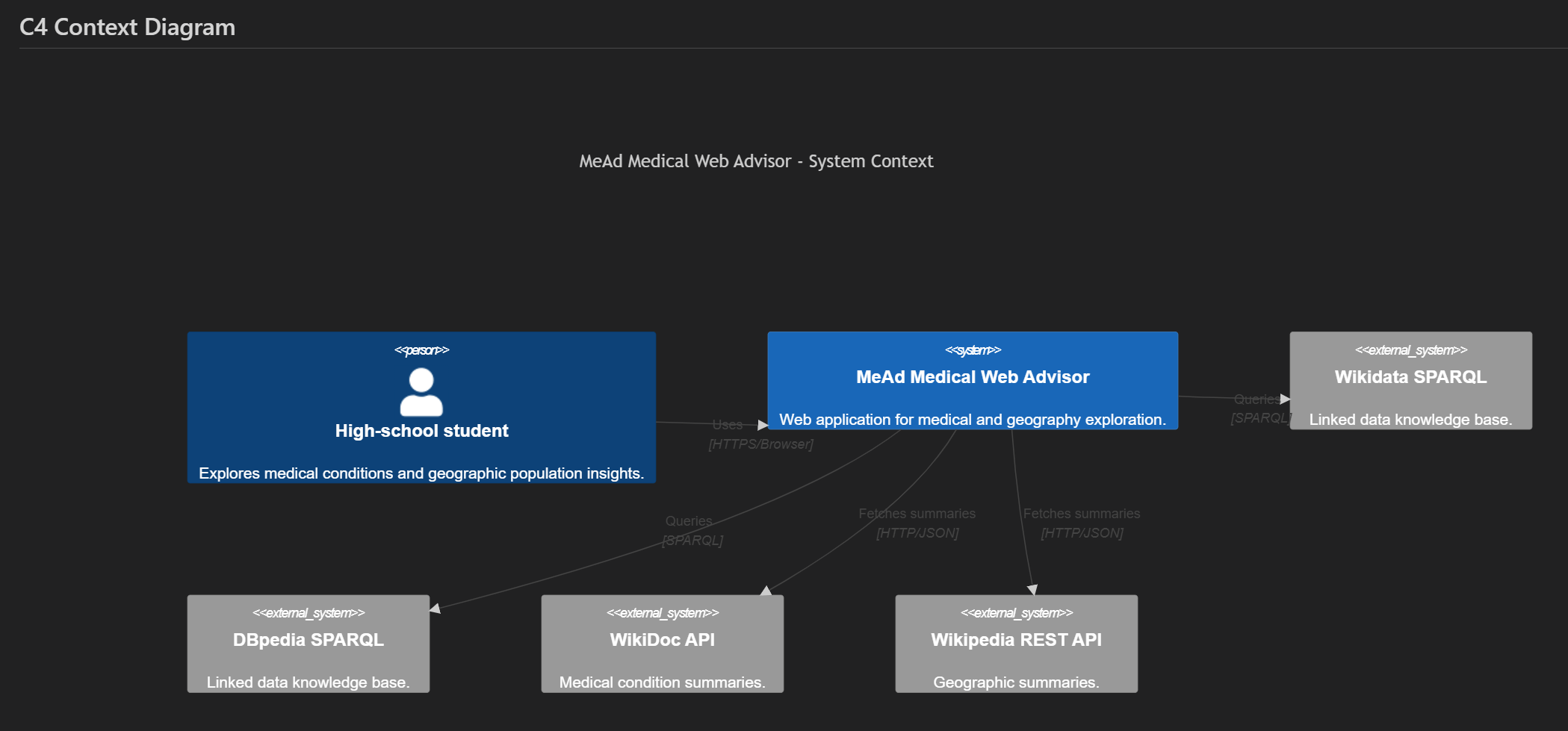
The context diagram shows the MeAd Medical Web Advisor system in relation to its users and external systems.
The primary user (High-school student) accesses the platform via browser. The system interacts
with multiple external data sources: Wikidata SPARQL and DBpedia SPARQL for
data enrichment, WikiDoc API for medical summaries, and Wikipedia REST API
for geographic summaries.
Figure 1. C4 Context Diagram - MeAd system in the context of users and external systems.
C4 Container Diagram
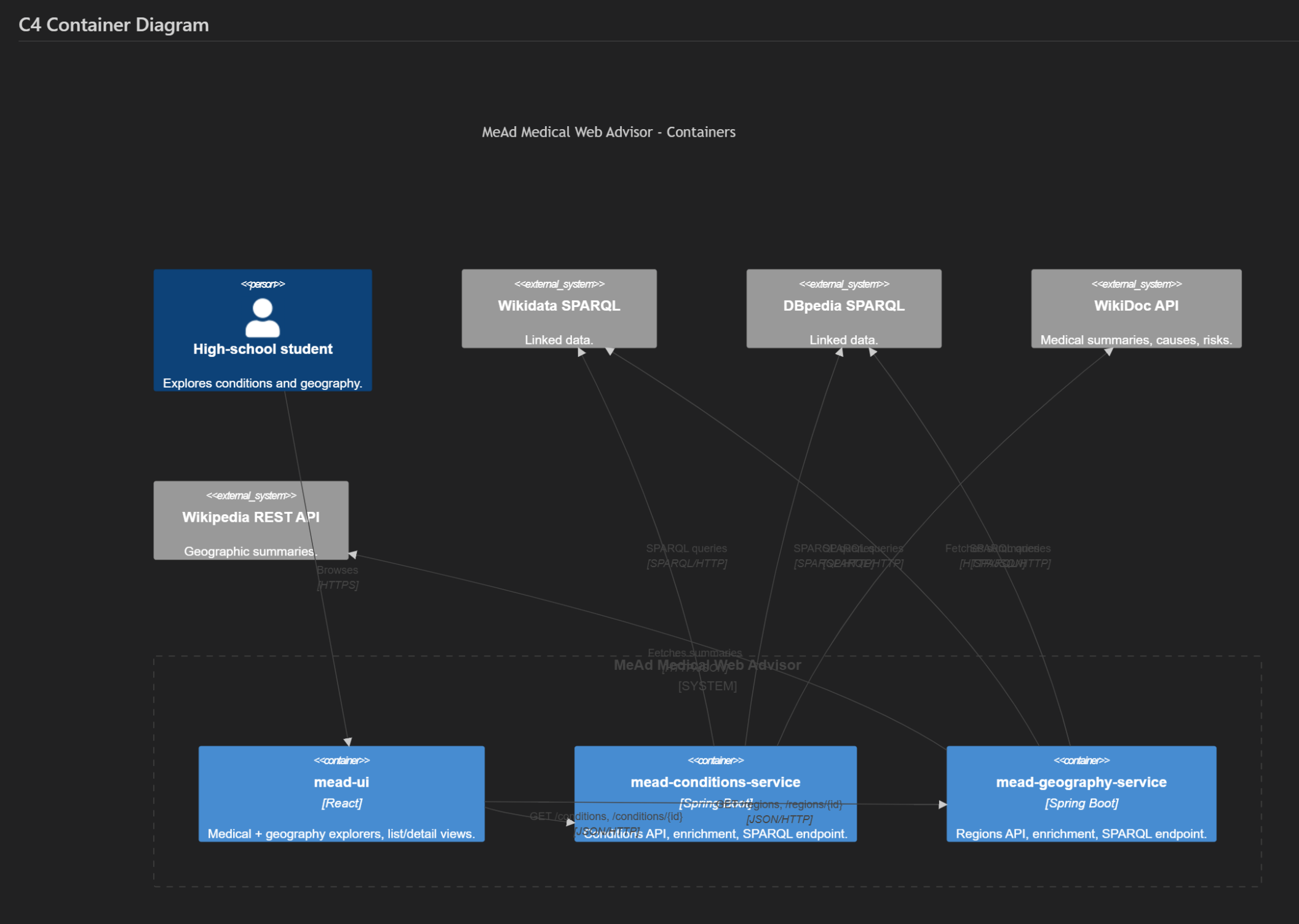
The container diagram details the main components of the MeAd system:
mead-ui [React] - User interface, single-page application with views for
exploring medical conditions and geographic data.
mead-conditions-service [Spring Boot] - REST microservice managing medical
conditions, providing API for CRUD, Wikidata/DBpedia enrichment, and a local SPARQL endpoint.
mead-geography-service [Spring Boot] - REST microservice for geographic locations
(continents, countries, cities), with the same enrichment and SPARQL capabilities.
All containers communicate via HTTP/JSON, and the backend services query external SPARQL endpoints
for additional data.
Figure 2. C4 Container Diagram - MeAd containers and their relationships.
C4 Component Diagram - Conditions Service
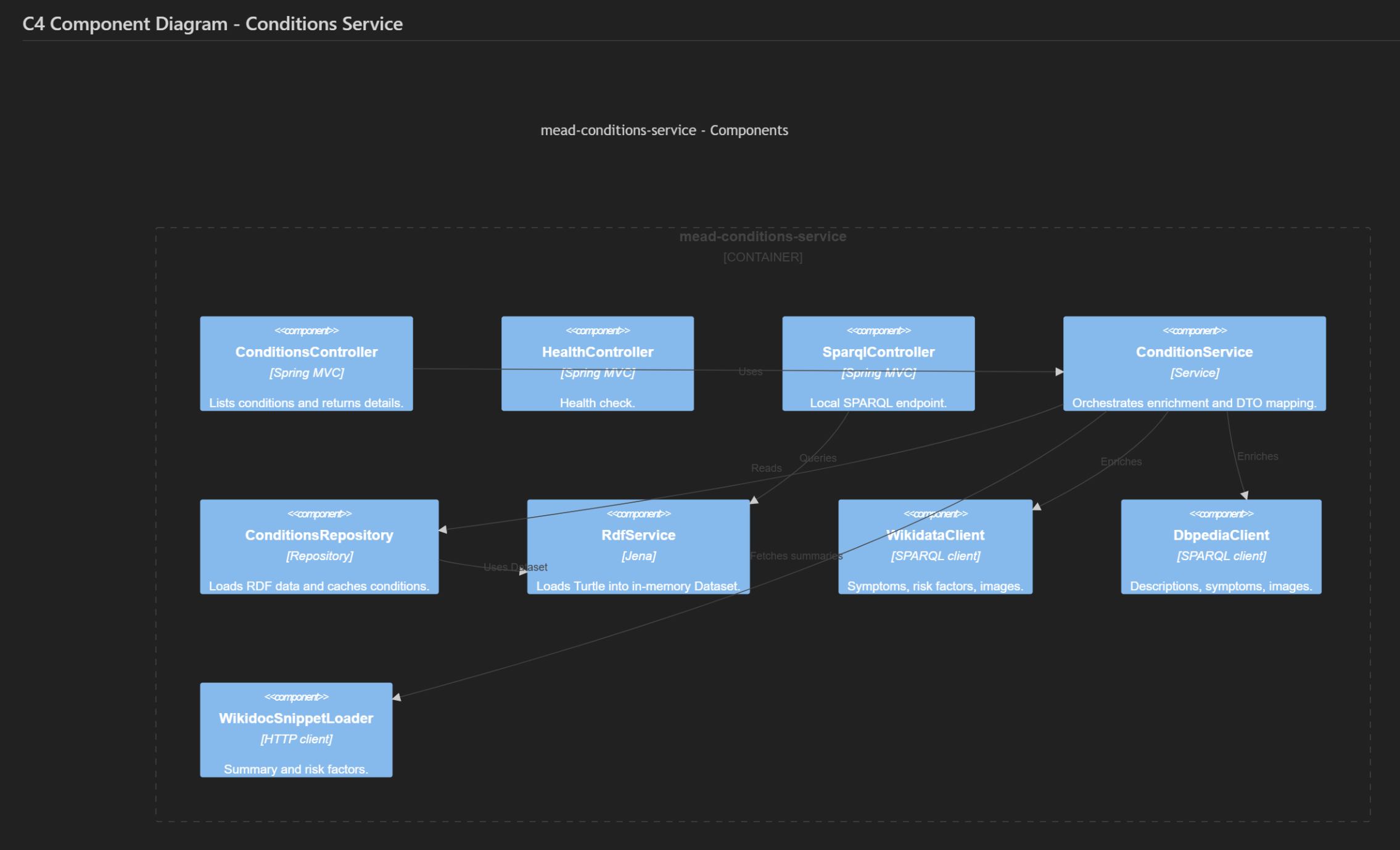
The component diagram for mead-conditions-service shows the internal architecture:
ConditionsController [Spring MVC] - REST endpoints for listing and condition details.
SparqlController [Spring MVC] - Local SPARQL endpoint for direct RDF queries.
HealthController [Spring MVC] - Health check endpoint.
ConditionService [Service] - Orchestrates enrichment and DTO mapping.
ConditionsRepository [Repository] - Loads RDF data and caches conditions.
RdfService [Jena] - Loads Turtle files into the in-memory Dataset.
DbpediaClient [SPARQL client] - Fetches descriptions, population, images from DBpedia.
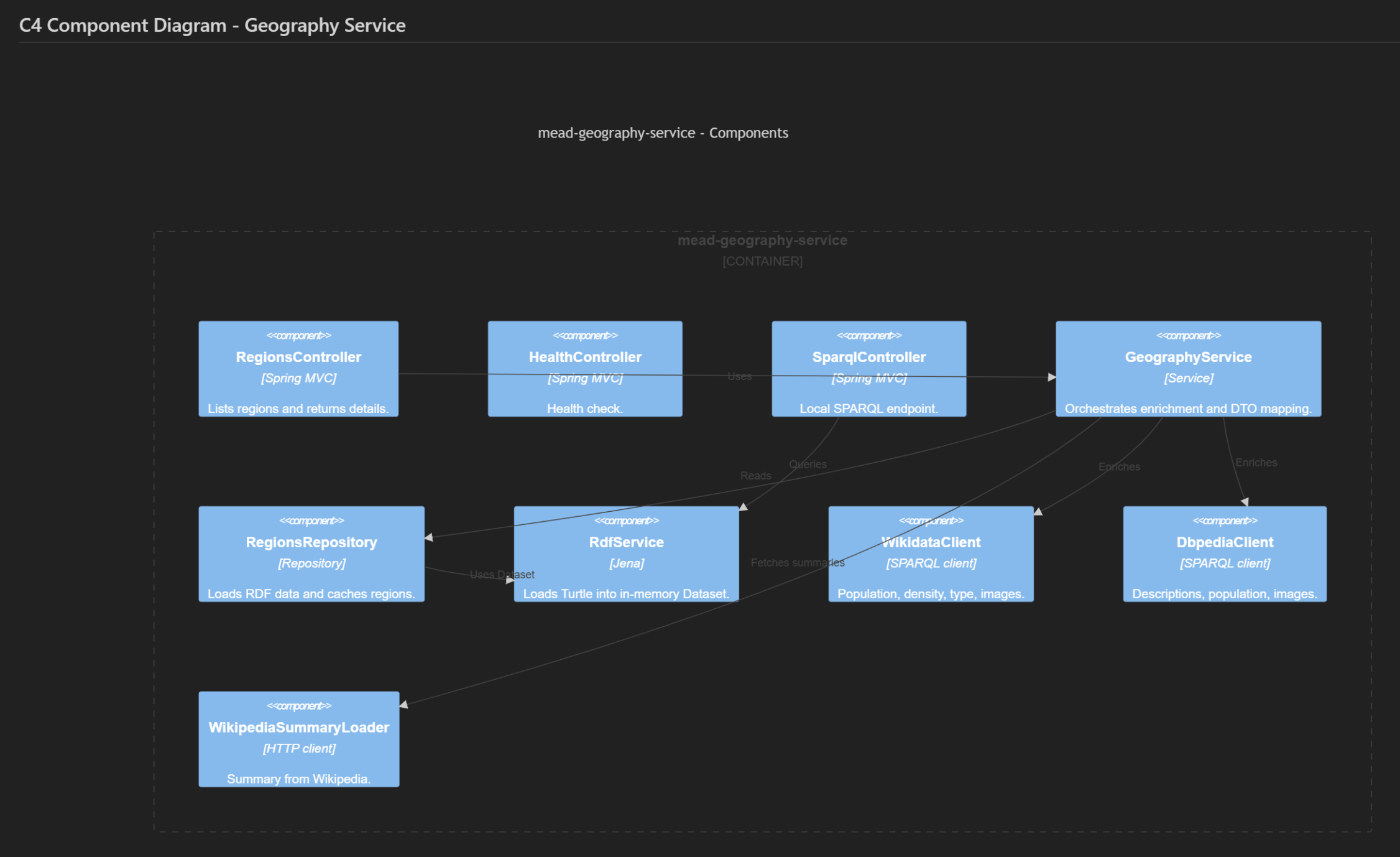
WikipediaSummaryLoader [HTTP client] - Loads summaries from Wikipedia REST API.
Figure 4. C4 Component Diagram - Internal components of mead-geography-service.
Each service loads its RDF dataset at startup into an in-memory Apache Jena transactional dataset. The datasets are
loaded from Turtle files located under src/main/resources/rdf. For the conditions service, enrichment is performed by
contacting Wikidata and DBpedia SPARQL endpoints in parallel, then merging, normalizing, and caching results.
2. Internal Data Structures / Models
The internal data structures define how medical conditions and geographic locations
are represented within the application. The core data model is designed to capture essential properties,
relationships, and classifications in a structured format that aligns with schema.org vocabulary. Both
microservices use Java records for immutable data transfer objects (DTOs) and repository patterns for
data access. Each entity includes schema:sameAs links to external knowledge bases (Wikidata and DBpedia)
for Linked Data interoperability.
2.1 Overview of Data Structures
The primary entities in the system are MedicalCondition and Place.
Each entity is associated with various attributes that describe its properties and external Linked Data links
to Wikidata and DBpedia knowledge bases.
Entity
RDF Type
Count
Service
MedicalCondition
schema:MedicalCondition
51 conditions
mead-conditions-service
Place
schema:Place
43 locations
mead-geography-service
2.2 Conditions Service Data Models
The conditions service uses Java records to represent data at different layers:
public record ConditionSummary(
    String id,            // Same as identifier
    String name,          // Human-readable name
    List<String> sameAs   // External knowledge base links
) {}
API Layer: ConditionDetail (Enriched View)
public record ConditionDetail(
    String context,       // "https://schema.org/"
    String id,            // Full URI: "https://mead.example/condition/asthma"
    String type,          // "MedicalCondition"
    String identifier,    // Slug identifier
    String name,          // Display name
    String description,   // From DBpedia/Wikidata (dbo:abstract, schema:description)
    List<String> images,  // Normalized image URLs from P18, dbo:thumbnail, foaf:depiction
    List<String> symptoms,     // From P780 (Wikidata) or dbo:symptom (DBpedia)
    List<String> riskFactors,  // From P5642 (Wikidata) or dbo:medicalCause (DBpedia)
    List<String> sameAs,       // External URIs for linked data traversal
    String wikidocSnippet      // Curated student-friendly summary (50 files)
) {}
Enrichment Records
// From WikidataClient
public record WikidataEnrichment(
    String description,
    List<String> symptoms,
    List<String> riskFactors,
    List<String> images
) {}

// From DbpediaClient
public record DbpediaEnrichment(
    String description,
    List<String> symptoms,
    List<String> riskFactors,
    List<String> images
) {}
2.3 Geography Service Data Models
The geography service manages 43 geographic locations including continents (Europe, Asia, Africa,
North America, South America, Antarctica), countries (Romania, Germany, France, Spain, Italy,
United States, United Kingdom, Japan, Canada, Australia, China, India, Brazil, Mexico, Egypt,
South Korea), and cities (Bucharest, Berlin, Paris, Madrid, Rome, New York City, London, Tokyo,
and many more).
Place Records
// Repository layer
public record Region(
    String identifier,           // "romania", "bucharest", "europe"
    String name,                 // "Romania", "Bucharest", "Europe"
    List<String> sameAs          // Wikidata/DBpedia URIs for Linked Data
) {}

// API layer
public record RegionSummary(String id, String name) {}

public record RegionDetail(
    String context,              // "https://schema.org/"
    String id,                   // Full URI: "https://mead.example/region/romania"
    String type,                 // "Place"
    String identifier,           // Slug identifier
    String name,                 // Display name
    List<String> sameAs          // External URIs for linked data traversal
) {}
Example Places in the Dataset
Category
Examples
Count
Continents
Europe, Asia, Africa, North America, South America, Antarctica
6
Countries
Romania, Germany, France, Spain, Italy, USA, UK, Japan, Canada, Australia, China, India, Brazil, Mexico, Egypt, South Korea
16
Cities
Bucharest, Iași, Cluj-Napoca, Timișoara, Brașov, Berlin, Paris, Madrid, Rome, New York City, Washington D.C., London, Tokyo, Ottawa, Canberra, Beijing, New Delhi, Brasília, Mexico City, Cairo, Seoul
21
2.4 RDF Model and Apache Jena Integration
Both microservices use Apache Jena with in-memory datasets loaded from
Turtle (.ttl) files at startup. Data is stored as RDF triples (subject-predicate-object).
The conditions service has 51 medical conditions, the geography service has 43 locations -
each with schema:sameAs links to Wikidata and DBpedia.
2.5 Vocabulary and Taxonomy Choices
The ontology is structured around core concepts using schema.org vocabulary.
This choice ensures interoperability with the broader Semantic Web and Linked Data ecosystem,
as schema.org is widely adopted by major search engines and linked data applications.
In RDF/OWL terminology, classes define the type of an entity
(used with rdf:type or a in Turtle syntax), while properties
(also called predicates) define relationships or attributes that connect
a subject to a value.
The application exposes Spring Boot-based RESTful APIs that interact with the underlying
RDF datasets. Each microservice provides endpoints to retrieve lists, fetch detailed information, and
execute SPARQL queries against the internal knowledge graph.
3.1 RESTful API Architecture
The APIs follow REST architectural principles:
Resource-oriented URLs – Collections and individual resources (e.g., /conditions, /conditions/{id})
HTTP Methods – GET for retrieval, POST for SPARQL queries
JSON Responses – All endpoints return JSON with application/json content type
JSON-LD Compatible – Response objects include context, id, and type fields for semantic web compatibility
CORS Enabled – Cross-origin requests allowed for frontend integration
3.2 Conditions Service API
The Conditions Service provides RESTful access to medical condition data. It serves
both lightweight summaries for listing/search and enriched details that aggregate
data from Wikidata, DBpedia, and WikiDoc API.
Endpoints Overview
Method
Endpoint
Description
Response
GET
/api/v1/conditions
List all 50 medical conditions
ConditionSummary[]
GET
/api/v1/conditions/{id}
Get enriched details for a specific condition
ConditionDetail
GET
/api/v1/health
Health check for monitoring
{"status":"OK"}
Response Models
ConditionSummary
Lightweight representation used in list responses. Contains only essential identification data:
Long-form description (dbo:abstract or schema:description)
symptoms
string[]
Wikidata/DBpedia
List of associated symptoms
riskFactors
string[]
Wikidata/DBpedia
Contributing risk factors or causes
images
string[]
Wikidata/DBpedia
URLs to relevant images
sameAs
string[]
local RDF
External entity URIs (Linked Data)
wikidocSnippet
string
WikiDoc API
Student-friendly educational summary
Example:
GET /mead-conditions-service/api/v1/conditions/asthma

{
  "context": "https://schema.org/",
  "id": "https://mead.example/condition/asthma",
  "type": "MedicalCondition",
  "identifier": "asthma",
  "name": "Asthma",
  "description": "long-term disease involving inflamed airways",
  "images": [
    "https://commons.wikimedia.org/wiki/Special:FilePath/Asthma.jpg",
    "https://commons.wikimedia.org/wiki/Special:FilePath/Asthma_attack.png"
  ],
  "symptoms": ["wheeze", "cough", "inflammation", "chest pain"],
  "riskFactors": ["air pollution", "smoking"],
  "sameAs": [
    "https://www.wikidata.org/entity/Q35869",
    "http://dbpedia.org/resource/Asthma"
  ],
  "wikidocSnippet": "Asthma is a long-term condition that affects the airways..."
}
3.3 Geography Service API
The Geography Service provides RESTful access to geographic location data. It serves
both lightweight summaries for listing and enriched details that aggregate
data from Wikidata, DBpedia, and WikiDoc API.
Endpoints Overview
Method
Endpoint
Description
Response
GET
/api/v1/regions
List all 43 geographic locations
RegionSummary[]
GET
/api/v1/regions/{id}
Get enriched details for a specific region
RegionDetail
GET
/api/v1/health
Health check for monitoring
{"status":"OK"}
Response Models
RegionSummary
Lightweight representation used in list responses:
Field
Type
Description
id
string
URL-safe identifier (slug) for API access
name
string
Human-readable location name
type
string
Resolved type from Wikidata (country, city, continent, or Place)
Full representation with enriched data from external sources:
Field
Type
Source
Description
context
string
static
Schema.org vocabulary reference
id
string
local RDF
Canonical URI for this region
type
string
Wikidata
Resolved type (country, city, continent, or Place)
identifier
string
local RDF
URL-safe slug
name
string
local RDF
Human-readable name
description
string
Wikidata/DBpedia
Long-form description
populationTotal
string
Wikidata/DBpedia
Total population count
populationDensity
string
Wikidata/DBpedia
Population per km² (calculated)
climates
string[]
Wikidata/DBpedia
Climate types (Köppen classification)
industrialDevelopment
string[]
Wikidata/DBpedia
Major industries in the region
culturalFactors
string[]
Wikidata/DBpedia
Languages, demonyms, cultural info
images
string[]
Wikidata/DBpedia
URLs to relevant images
sameAs
string[]
local RDF
External entity URIs (Linked Data)
wikidocSnippet
string
WikiDoc API
Student-friendly educational summary
Example:
GET /mead-geography-service/api/v1/regions/romania

{
  "context": "https://schema.org/",
  "id": "https://mead.example/region/romania",
  "type": "country",
  "identifier": "romania",
  "name": "Romania",
  "description": "Romania is a country in Southeastern Europe...",
  "populationTotal": "19053815",
  "populationDensity": "80.12",
  "climates": ["humid continental climate", "oceanic climate"],
  "industrialDevelopment": ["automotive industry", "information technology"],
  "culturalFactors": ["Romanian", "Romanians"],
  "images": ["https://commons.wikimedia.org/wiki/Special:FilePath/Romania_location_map.svg"],
  "sameAs": [
    "https://www.wikidata.org/entity/Q218",
    "http://dbpedia.org/resource/Romania"
  ],
  "wikidocSnippet": "Romania is a country located in southeastern Europe..."
}
4. RDF-Based Knowledge Model
This section describes the design decisions, expressiveness, and real-world usage of the RDF-based
knowledge models employed by MeAd. The system uses a lightweight yet expressive ontology based on
schema.org vocabulary, extended through linked data connections to established knowledge bases.
4.1 Ontology Design Decisions
The knowledge model follows these design principles:
Schema.org as foundation: Using widely-adopted vocabulary ensures compatibility with search engines and semantic web tools
Minimal local vocabulary: Only introducing custom URIs where schema.org doesn't provide suitable classes
Linked Data extensions: Leveraging schema:sameAs to connect to richer external ontologies
Separation of concerns: Distinct datasets for medical conditions and geographic data
Figure 2. Knowledge graph structure showing internal entities and external knowledge base connections.
5. External Data Sources and SPARQL Integration
MeAd integrates external data using SPARQL queries against public knowledge bases. The two primary
sources are Wikidata (structured, multilingual facts) and DBpedia
(Wikipedia-derived knowledge), with the WikiDoc API providing curated
student-friendly medical summaries.
5.1 Wikidata Knowledge Base Integration
The WikidataClient fetches enriched data from Wikidata's SPARQL endpoint.
All queries run in parallel using CompletableFuture for optimal performance.
Data Retrieved
Data
Wikidata Property
Example (Asthma)
Description
schema:description
"chronic lung disease"
Symptoms
wdt:P780
wheezing, coughing, chest tightness
Risk Factors
wdt:P5642
allergies, air pollution, smoking
Images
wdt:P18
Wikimedia Commons URLs
Example SPARQL Query (Symptoms)
SELECT DISTINCT ?symptomLabel WHERE {
  wd:Q35869 wdt:P780 ?symptom .
  SERVICE wikibase:label { bd:serviceParam wikibase:language "en". }
} LIMIT 30
5.2 DBpedia Enrichment Strategies
The DbpediaClient fetches Wikipedia-derived data from DBpedia's SPARQL endpoint.
It uses fallback chains to maximize data coverage when primary properties are empty.
schema:sameAs links to Wikidata and DBpedia for each entity
6. User Guide
Use Cases
Case Study 1: Exploring a Medical Condition
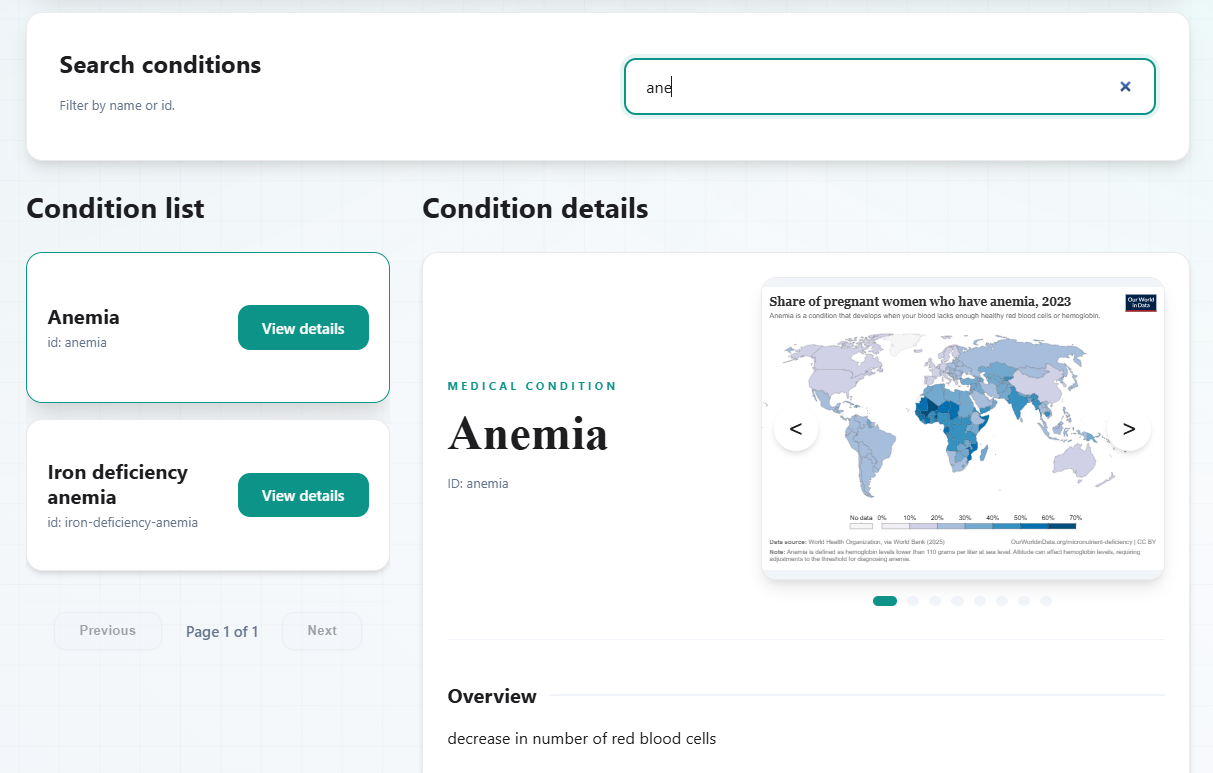
Search: Users can filter conditions by typing in the search bar.
The list updates instantly, showing matching conditions (e.g., "Anemia", "Iron deficiency anemia").
Clicking "View details" opens the condition detail page.
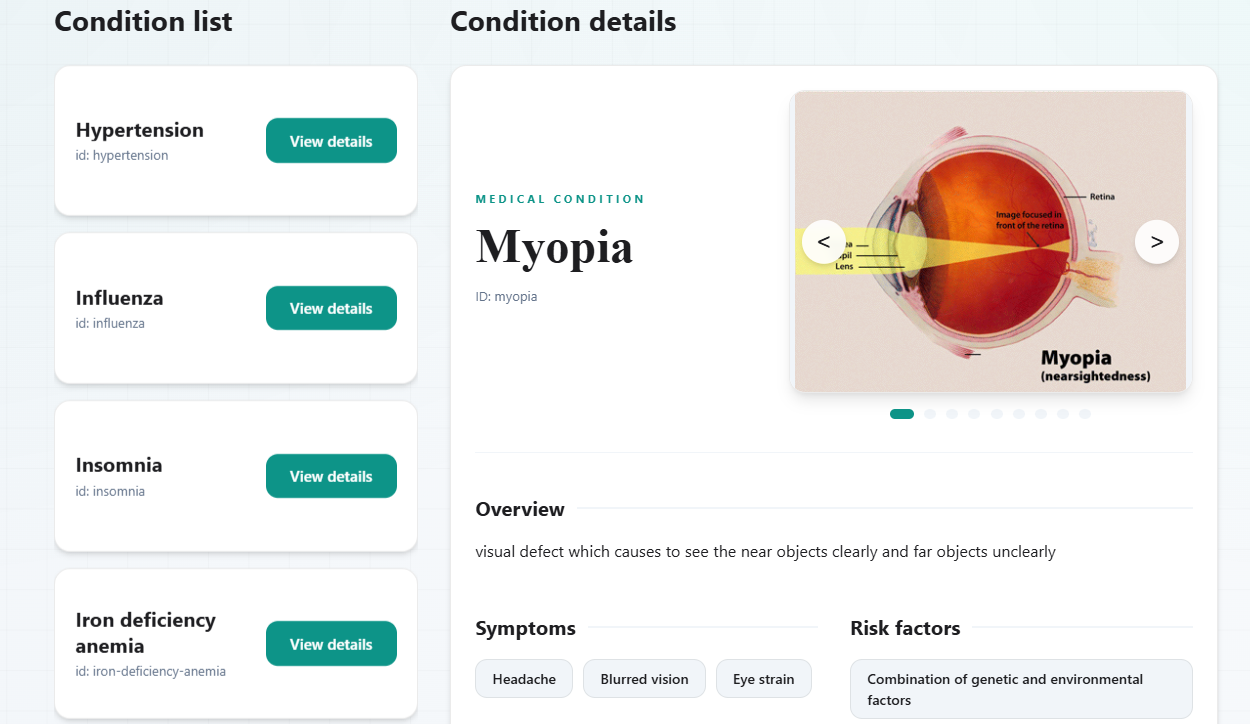
Detail: The condition page displays enriched information from Wikidata and DBpedia:
image carousel, description, symptoms (e.g., "Headache", "Blurred vision"), and risk factors.
Case Study 2: Exploring Geographic Data
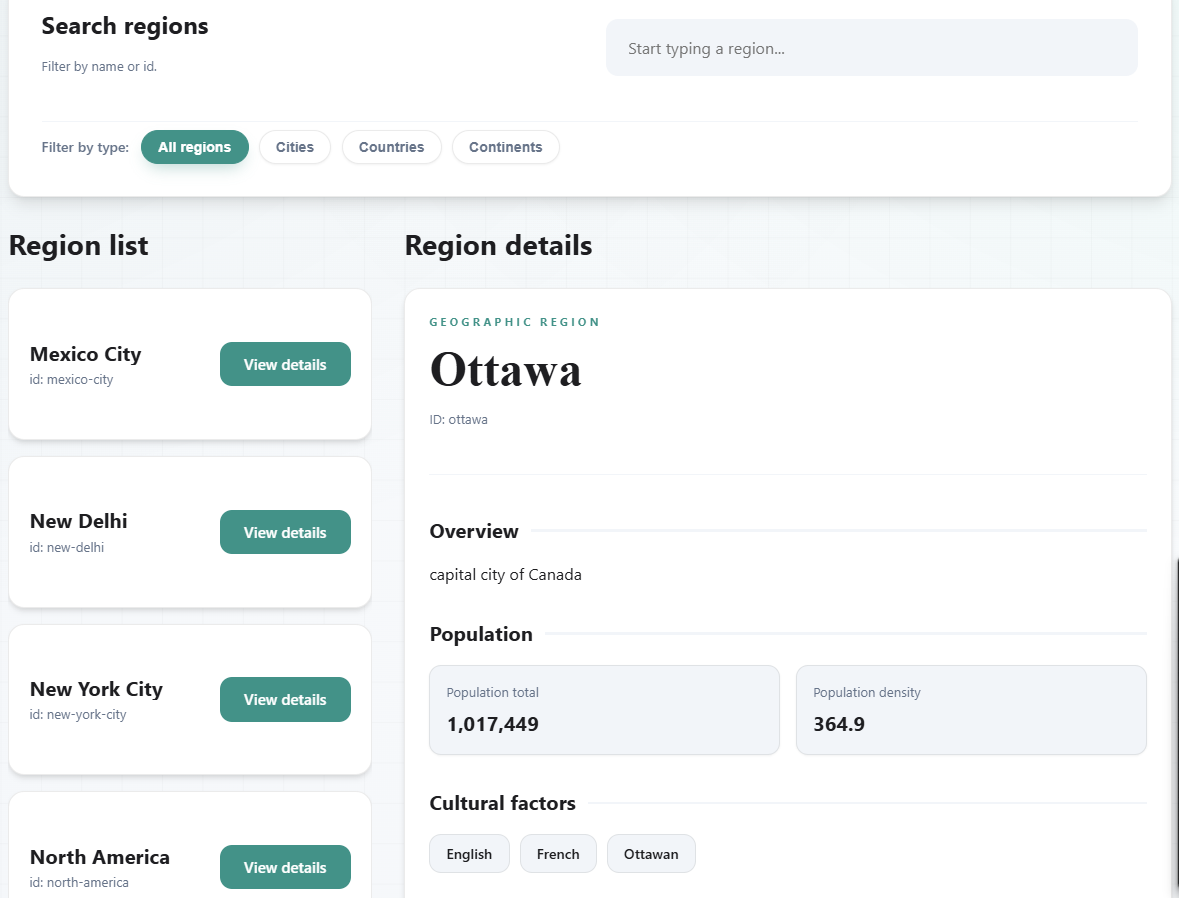
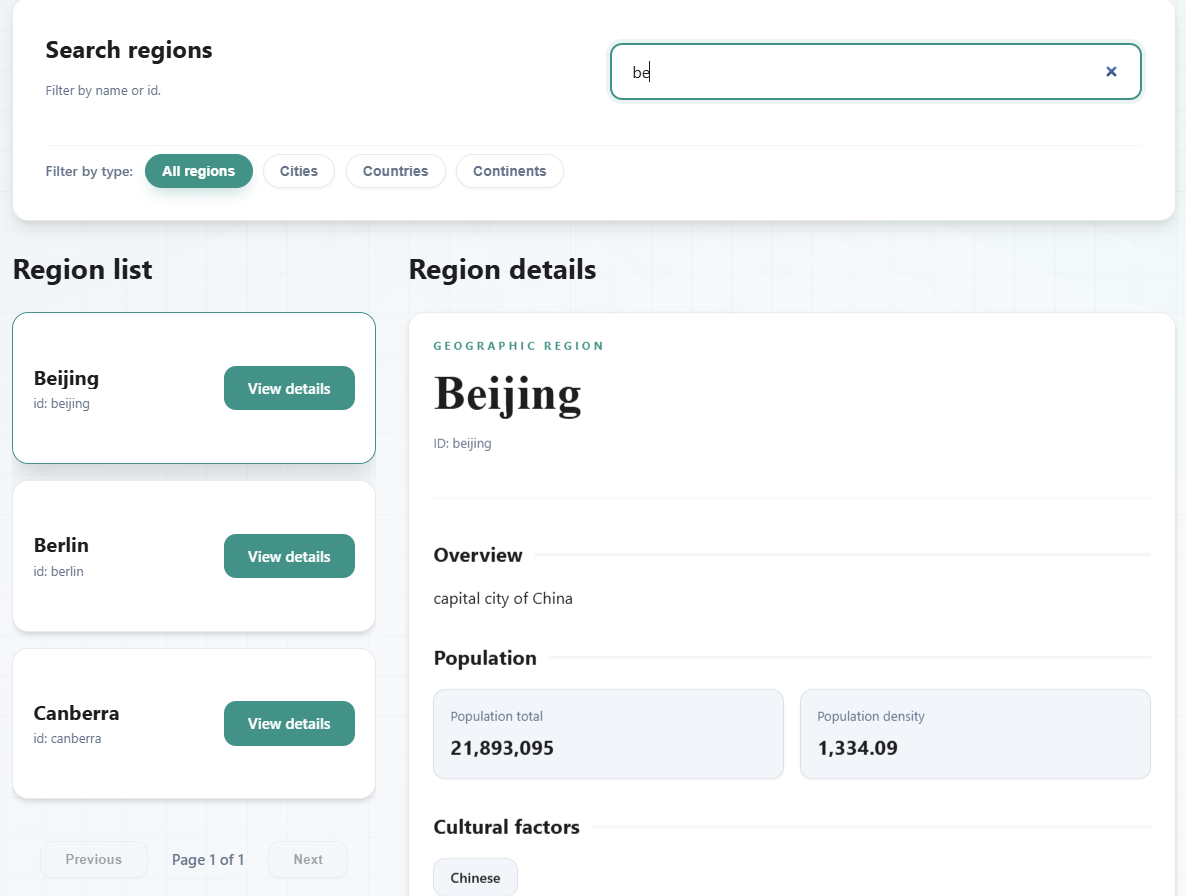
List: The Geography service provides 43 locations organized by type
(continents, countries, cities). Each location shows its name, type, and Linked Data references.
Detail: Each region displays enriched data from Wikidata: population,
climate types, industries, cultural factors, and images.
7. Video Demonstration
A comprehensive video demonstration showing the MeAd Medical Web Advisor platform in action:
Video demonstration of the MeAd platform.
9. References
Knowledge Bases
Wikidata – Free and open knowledge base with structured data